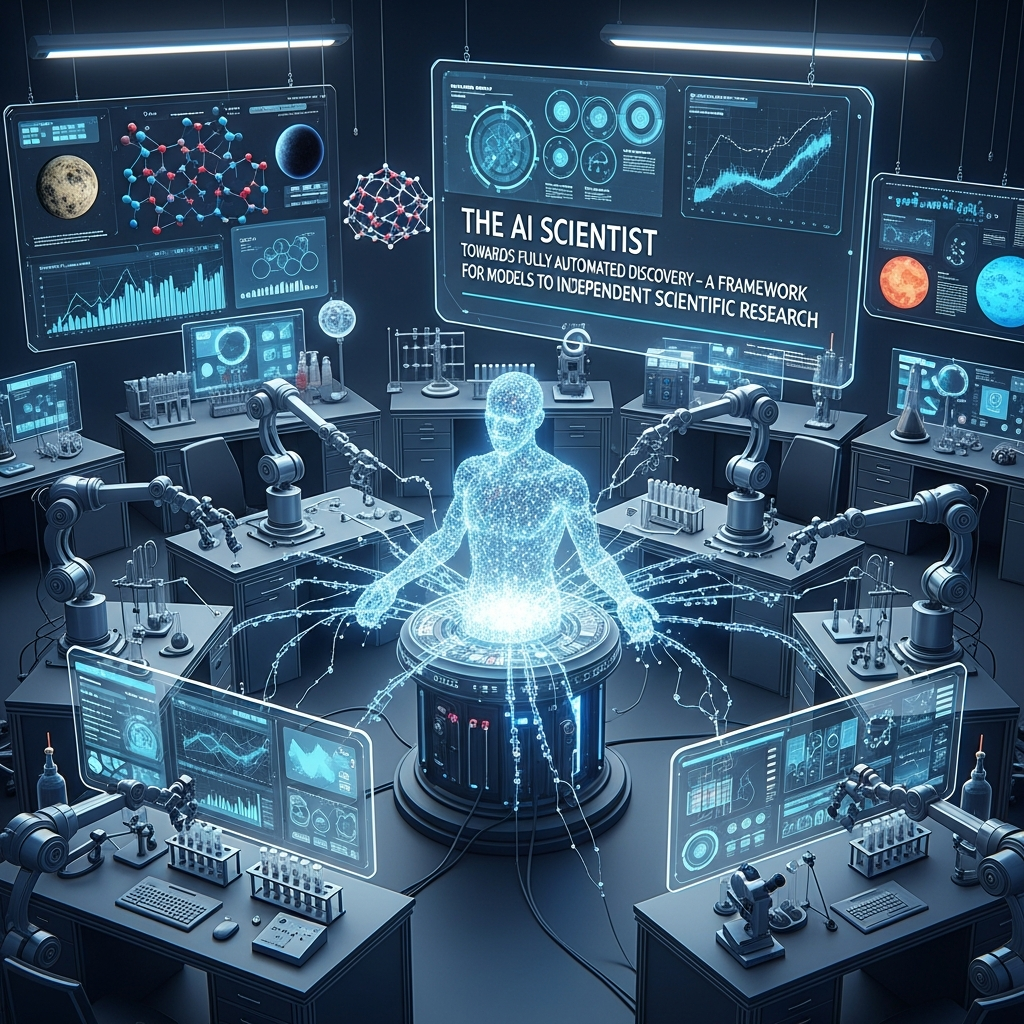
The AI Scientist
The framework aims to enable models to conduct independent scientific research, moving towards fully automated discovery.
AI is having a big effect on many fields, such as healthcare, finance, entertainment, and transportation. But one of the most exciting and important ways to use AI is in scientific research. Imagine a world where AI is not only a tool for scientists but also a part of the process of discovering new things. The idea of an "AI scientist" is getting us closer to a time when models can do scientific research on their own, make guesses, run tests, and draw conclusions without any help from people. This article discusses the framework for these models and their implications for science's future.
The Rise of AI in Research
In the last few years, AI has become an important part of scientific research. People have utilised it for various purposes, such as understanding the structure of proteins and discovering new materials for renewable energy. Machine learning models that look at big datasets, model complicated systems, and even make new drug candidates are already helping scientists. AI in science is mostly a tool to help human researchers right now, not a replacement for them.
The concept of an AI scientist goes even further. An AI scientist could not only help but also do scientific research on its own, like:
Formulating Hypotheses: By utilising its existing knowledge, the AI model can generate novel research enquiries that were not previously considered.
AI can make plans and run tests to see if ideas are correct, look for problems, and make research methods better.
Data Analysis: Advanced AI algorithms can look at and work with large amounts of data much faster than people can. This can help you find patterns and insights that you might have missed.
Drawing Conclusions and Publishing Results: The AI can figure out what the data means on its own, write research papers, and even come up with new theories based on what it finds.
This idea of fully automated scientific research makes us wonder what scientists will do in the future, whether AI-driven discoveries are ethical, and whether speeding up scientific progress could be beneficial.
A Framework for Autonomous Scientific Inquiry
A strong framework must have several important parts in order for AI to be able to do its own scientific research. You can break these parts down into five steps: collecting data, making a guess, running experiments, looking at the results, and publishing the results.
1. Getting and putting together data
The first step in any scientific discovery is to collect data. A lot of traditional scientific research involves collecting data, which often means doing long and expensive experiments. An AI scientist would automatically collect data from many different places, like sensors, existing databases, and experiments that are done directly. AI models could automatically gather and sort this information from a variety of scientific fields, making sure that it is up-to-date, useful, and well organised.
The AI could also learn more from the vast amount of scientific literature that is available to the public. This would ensure that it has access to all the information that is out there on the subject. You can use Natural Language Processing (NLP) models to read research papers, books, and articles in several languages and scientific fields and get useful information from them.
2. Coming up with a guess
The AI has to think of possible reasons after it has collected the data. In traditional research, scientists usually start with a hypothesis that is based on theories that already exist and data from the real world. AI could do the same thing by using advanced models to look at what we already know about science, figure out where that knowledge is lacking, and come up with new questions for research.
AI models, especially deep learning models, can look at a lot of data and identify patterns and links that people might not be able to see. For example, an AI model might identify links between environmental factors and the spread of disease that weren't clear before, which could lead to new areas of research.
3. Planning and carrying out tests
The next step is to make plans and do experiments to find out if the hypotheses are correct. When you design an experiment in traditional science, it takes a long time and often involves trying things out. AI can use algorithms to predict outcomes based on the hypothesis and past data.
AI models can also figure out the best settings for experiments, which saves time and money when testing in real life. AI can sometimes run virtual experiments, like simulating how molecules interact when looking for new drugs or running simulations of physical phenomena to see if a theory is true. You could, for instance, use reinforcement learning (RL) models to test out different plans and pick the best ones.
4. Analysing the results and interpreting their significance is essential.
You need to look at the data after an experiment to figure out what it means. AI has been adept at looking at large amounts of data for decades. Such analysis is a very useful skill in scientific research. AI models can quickly look at and analyse the results of thousands of experiments, finding patterns and linking variables that might be hard for people to see.
AI models can change the experiment's settings in real time, which is even more important. This helps the research process become better and better. These models can also use advanced statistical methods to make sense of the data. This procedure makes sure that the conclusions are both correct and useful.
5. Drawing conclusions and sharing the results
Once the analysis is complete, the AI must comprehend the results and formulate conclusions. This is when it's crucial for the AI to be able to think critically and reason. Advanced reasoning models can look at the results and tell you if the hypothesis has been proven or disproven. They can also suggest other ways to look into it.
The last step is to publish the results. Traditionally, this involved draughting a scientific paper, seeking review from other scientists, and subsequently publishing it in a scientific journal. An AI scientist can speed things up by writing the paper based on what it found and sending it to journals. You might even be able to talk to the editors about it. You could use GPT-3 and other models that can make natural language to write research papers that are clear, correct, and obey the formatting rules set by journals.
Problems and Issues with Ethics
It's an interesting idea to have an AI scientist, but it also raises a lot of moral questions. Who wrote it is one of the biggest concerns. If an AI model does the research and writes the paper, who owns the work? Should the AI be credited as the author, or should the people who made it be credited?
Another moral issue is responsibility. If an AI makes a mistake in its research or comes to the wrong conclusion, who is to blame? It will be important to make sure that AI models are clear, easy to understand, and follow the right rules to keep people safe.
AI is also taking over more and more parts of scientific research. This means that the data and algorithms it uses might be biased, which could change the results. It will be important to train AI models on a wide range of representative datasets and put them through a lot of testing to avoid these biases.
What Will Happen to AI Researchers in the Future
The concept of AI Scientists offers a vision of a future where scientists can accelerate, improve, and collaborate more effectively. But it won't replace human researchers. AI will be a valuable partner in science, speeding up research and making discoveries that would be impossible without people.
The framework for fully autonomous scientific discovery will improve as AI improves. This will allow models to not only help but also be at the forefront of new research. The AI scientist is the next big thing in science. It's the place where human creativity and AI meet to begin a new era of discovery.
In short, the AI scientist is not just a thought for the future; it is a vision for the future of science. Advances in AI and machine learning will bring about a significant transformation in scientific research methods. Models will not only help scientists, but they will also do their own research, make discoveries, and change how we think about the world.
Written by M Rousol
Senior Editor at AIUPDATE. Passionate about uncovering the stories that shape our world. Follow along for deep dives into technology, culture, and design.
View ProfileEnjoying this article?
Our independent journalism is made possible by readers like you. If you found this story valuable, please consider supporting us.


Discussion
Join the chatLog in to comment
Join the community discussion and share your thoughts.
Sign In / RegisterNo comments yet. Be the first to start the conversation!