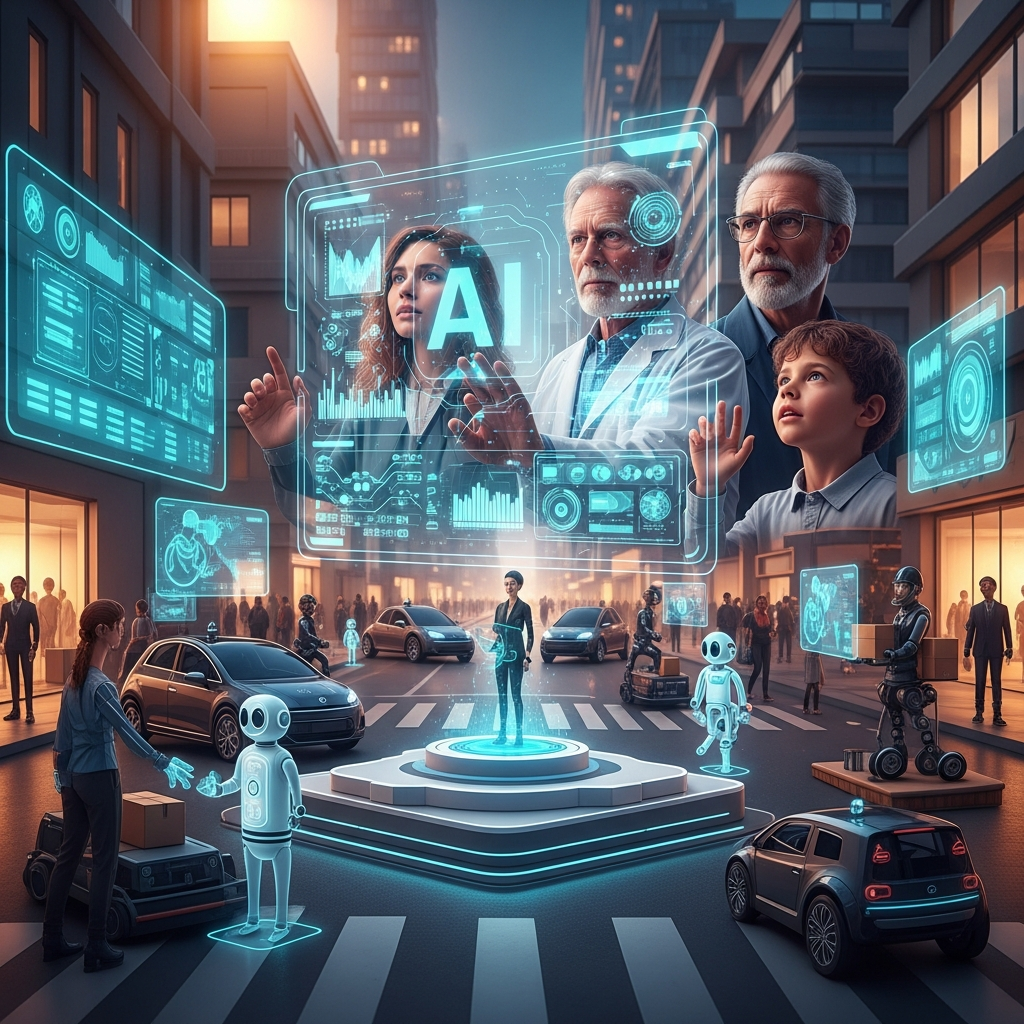
AI – The Artificial Intelligence Future in 2026
The fast development of artificial intelligence (AI) is no longer a storyline for science fiction; rather, it represents the most significant technical upheaval that our civilisation has ever witnessed. Currently, artificial intelligence (AI) is not only a tool that may assist students in writing essays or solving mathematical problems; rather, it is a fundamental force that will have a significant impact on your future job, your education, and the way you engage with the world.

Here is a comprehensive look at the future of artificial intelligence and what it means for you as we go forward into the year 2026 and beyond.
1. The Transition to "Agentic" Artificial Intelligence
We have witnessed generative artificial intelligence (such as ChatGPT or Gemini) that responds to your requests throughout the course of the previous several years. Agent-based artificial intelligence will become increasingly prevalent in the future.
Rather than just composing a paragraph, an artificial intelligence "agent" is able to carry out tasks that involve many steps. For instance, a student agent would not only summarise a research subject; it would also be able to locate credible sources, arrange them in a bibliography, plan your study periods, and even generate a project outline based on the curriculum that your instructor has provided.
The impact will be that artificial intelligence will transition from being a "search engine" to a "personal assistant" that will manage the logistics of your life, allowing you to concentrate on strategy and creativity at a higher level.

2. Personalised Learning: The "Tutor for Everyone" The field of education is currently experiencing a revolution through the process of "mass-personalisation". Throughout the course of history, classrooms have had difficulty utilising the "one-size-fits-all" concept.
Future artificial intelligence platforms will be able to adjust to your unique learning style in real time, resulting in hyper-personalisation. An infographic may be generated by the artificial intelligence to explain physics to you if you are a visual learner. The development of a virtual simulation might be possible if you learn better via doing.
Artificial intelligence (AI) technologies are becoming increasingly strong to the point that they may serve as instructors around the clock, delivering rapid feedback on homework assignments and teaching difficult topics in a manner that is tailored to the individual's current level of comprehension.

3. The Job Market of the Future: Augmentation, Not Just Replacement Employment Trends
One of the most widespread concerns is that "AI will take all the jobs." A more complex truth is that artificial intelligence will not replace humans; nevertheless, humans who utilise AI will replace those who do not use AI.

Those with a High Impact: the Industry What the Future Holds for Artificial Intelligence
Medical care: Pattern recognition in scans will be utilised by AI to aid medical professionals in making early diagnoses of illnesses.
AI Coding Assistants: The repetitive aspects of programming will be handled by "AI Coding Assistants" in engineering, which will allow engineers to concentrate on programming architecture.
co-creator: Arts of Creativity A "co-creator" role will be played by artificial intelligence in the areas of storyboarding, colour grading, and music creation.
Viability Artificial Intelligence: Long-term viability Artificial intelligence will improve the efficiency of energy grids and assist scientists in the discovery of novel materials for batteries.
AI Literacy: An important student insight is that gaining "AI Literacy" is necessary in order to future-proof your job. Therefore, it is not necessary for you to be a computer scientist; nonetheless, you should be familiar with the ways in which artificial intelligence technologies might enhance your own productivity and problem-solving talents.
4. Challenges Concerning Ethical Issues: The Responsibility of the User
As artificial intelligence (AI) gets more powerful, the ethical stakes become more significant. There are numerous important aspects that students need to be aware of:
Algorithmic bias occurs when artificial intelligence models are educated on human data, which frequently incorporates biases. Artificial intelligence has the potential to perpetuate preconceptions regarding race, gender, and culture if we are not careful.
As a result of the capacity to make convincing video and audio, "seeing is no longer believing." Deepfakes and misinformation are becoming increasingly common. It is likely that the most useful talents you may acquire are those that involve critical thinking and fact-checking.
In order to improve its ability to deliver better service, artificial intelligence (AI) "gets to know you" and accumulates massive quantities of personal data. It is critical that you have a solid understanding of how to safeguard your digital presence.

5. Abilities That Artificial Intelligence Is Not Able to Replace
AI is capable of processing data at a quicker rate than any human being; however, it is lacking in several areas of "human intelligence". In order for pupils to be successful, they should focus on developing certain talents that are unique to humans:

Emotional Intelligence and Empathy: Artificial intelligence is not capable of fully feeling or comprehending the complexities of human emotion.
The capacity to make moral judgements in "grey areas" is still a human domain, according to complex ethics.
To engage in critical thinking, one must question the reasons behind the production of a certain outcome rather than just accepting it.
Artificial intelligence is only as good as the prompt it is given; therefore, curiosity refers to the capacity to ask the proper questions.
"The best way to predict the future is to create it." It was Peter Drucker.

Conclusion
It is not something that is just "happening" to you; rather, the future of artificial intelligence is a landscape that you will help construct. You have the ability to take the lead in this new digital frontier if you use these technologies in a responsible manner and concentrate on the abilities that are uniquely yours as a human being.
Written by M R Gurmani
Senior Editor at AIUPDATE. Passionate about uncovering the stories that shape our world. Follow along for deep dives into technology, culture, and design.
View ProfileEnjoying this article?
Our independent journalism is made possible by readers like you. If you found this story valuable, please consider supporting us.
Discussion
Join the chatLog in to comment
Join the community discussion and share your thoughts.
Sign In / RegisterNo comments yet. Be the first to start the conversation!