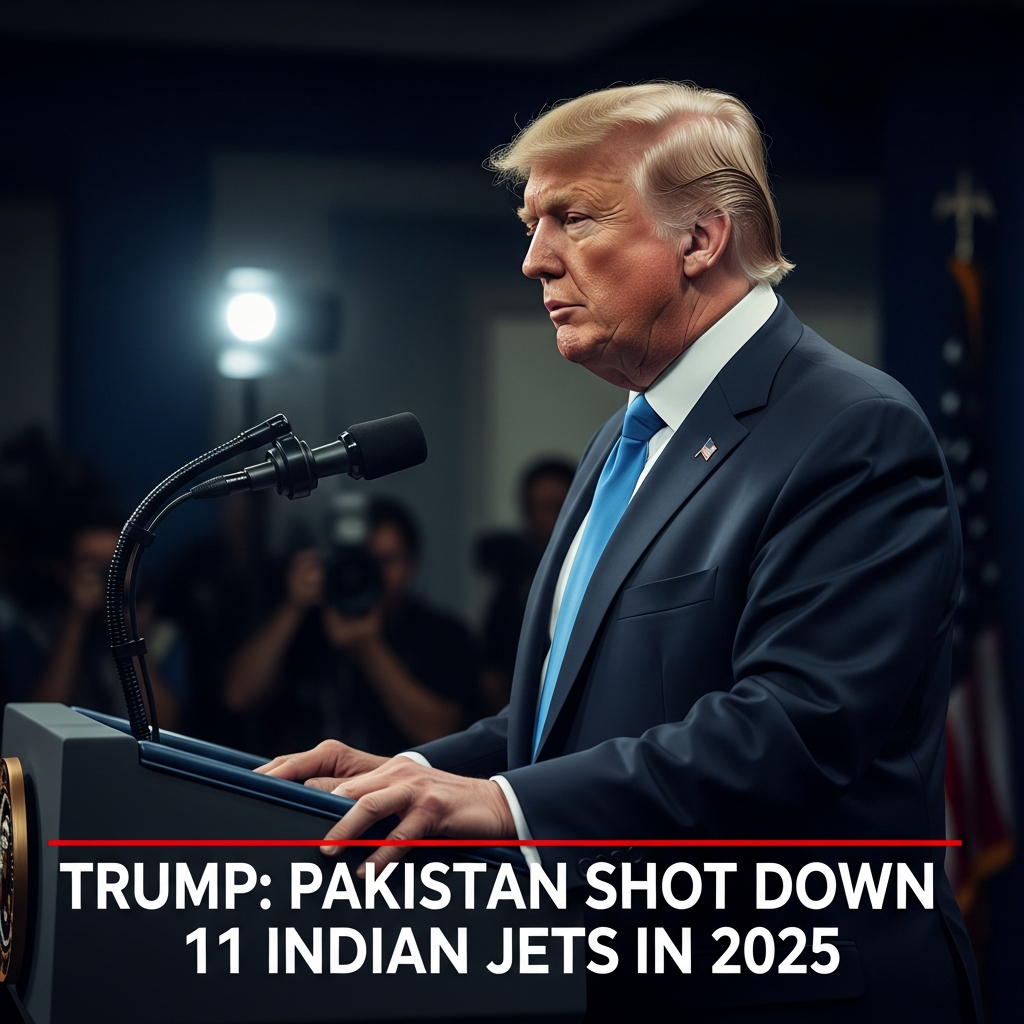
Trump Speaks at Gaza Peace Board: Trump Says He Helped Prevent an India–Pakistan War—Again—And Boasts About Fighter Jets
WASHINGTON/GAZA/NEW DELHI/ISLAMABAD — U.S. President Donald Trump steered clear on Thursday of endorsing a two-state solution to the Israeli-Palestinian conflict, a departure from longstanding U.S. policy in the region. He also repeated his disputed assertion that Pakistan had “shot down 11 Indian fighter jets” in previous hostilities.
The comments quickly ricocheted through diplomatic and strategic circles in Washington, New Delhi, and Islamabad, reigniting the debate over how deeply the United States should get involved in South Asian crisis management by resurfacing unanswered questions about disputed military fatalities during the 2019 India-Pakistan standoff.
The Gaza forum was supposed to center on ceasefire efforts, humanitarian corridors, and reconstruction plans for the Palestinian enclave— but Trump’s remarks suddenly placed South Asian geopolitics on the agenda and renewed scrutiny of history.
South Asia Remarks Upstage Gaza Diplomacy
The Gaza Peace Board is a high-level platform speaking on behalf of efforts to stabilise policy establishments in the Middle East. Speakers included laying out lessons learned about post-conflict stabilisation, the design of security guarantees, and the rambling architecture of U.S. engagement in unstable regions.
But in his address, Trump swivelled unexpectedly toward what he called one of the key diplomatic accomplishments of his administration.
“I saved a war between India and Pakistan,” Trump said. It would have been a catastrophic war involving nuclear powers. We started something, and we stopped it.”
During the speech, he offered no documentary evidence, transcripts, or detailed timelines for his specific interventions. Instead, he pointed to his previous talks with heads of state from both nations and described U.S. diplomacy as playing a pivotal role in effectively lowering tensions.
The remarks were reminiscent of similar commentary made by Trump in 2019 and 2020 when he said that he’d offered to mediate between India and Pakistan at a time of heightened military tension.
The 2019 Crisis: What Happened
The president’s comments come in the news of a February 2019 escalation between India and Pakistan, one of the most serious confrontations between the two nuclear-armed neighbours in decades.
Pulwama Attack
On February 14, a suicide bombing claimed the lives of forty Indian paramilitary soldiers. In more violence on Wednesday, an Indian police officer and a civilian were also killed when militants fired at security forces near the site of another gunbattle in Pulwama town, said Dilbagh Singh, the director-general of police in Jammu and Kashmir. The Pakistan-based militant group Jaish-e-Mohammed took responsibility.
India blamed Pakistan for coddling and supporting the group — a charge Islamabad denied.
Balakot Airstrikes
India carried out airstrikes on Feb. 26, 2019, against what it said was a militant training camp deep inside Pakistani territory in the town of Balakot. India called the strike a “non-military preemptive action.".
Pakistan challenged the extent and success of the strike, saying Indian aircraft released their payload in a forest without causing any major damage.
Aerial Engagement
Pakistan carried out the retaliatory air strikes on Feb 27. A dogfight ensued.
Pakistan said it downed two Indian planes and captured an Indian Air Force pilot, Wing Commander Abhinandan Varthaman. India admitted it had lost a single MiG-21 Bison jet and said the pilot was missing after he used an ejector seat in Pakistani territory.
Pakistan later freed the pilot with what its prime minister, Imran Khan, called a "peace gesture."
India never admitted to losing so many planes. Open-source intelligence assessments and independent defence analysts largely recorded the acknowledged loss of one Indian MiG-21 and a possible downing of a Pakistani F-16— a potential that Pakistan disputes.
The “11 Fighter Jets” Claim
Trump’s latest claim that Pakistan “shut down 11 Indian fighter jets” is far above publicly discussed figures.
The public received no official estimates of such high losses from the Indian or international military. Satellite photos and independent defence specialists, as well as reporting by news outlets, including Reuters, the New York Times, and the Washington Post at the time, did not support such a high loss of aircraft.
India has consistently asserted that its air operations have achieved strategic goals and have contained losses.
Defence analysts point out that air combat losses involving 11 jets likely would have produced extensive physical, radar, and satellite evidence. None has been independently verified.
Thus, publicly available data does not support the claim.
U.S. Role in De-escalation
While one may question Trump's statements, there is evidence that U.S. officials engaged in intensive diplomacy during the 2019 crisis.
Former Secretary of State Mike Pompeo wrote in a memoir that he was awakened during the crisis by fears over potential escalation, and American officials scrambled to tamp down rising tensions. Pompeo discussed talks with Indian and Pakistani leaders to deter further military action.
There has been a flurry of diplomatic activity since, including calls by U.S. National Security Adviser John Bolton to New Delhi and Islamabad. The State Department publicly called on both sides to show restraint.
Several international players, including Saudi Arabia, the United Arab Emirates and China, were said to have been involved in behind-the-scenes diplomacy.
The widespread consensus among analysts is that a mix of back-channel diplomacy, economic interests and nuclear deterrence has so far prevented further escalation.
But experts warn that crisis de-escalation in South Asia is generally a multilateral affair, rather than being neatly settled by one bold stroke.
India’s Position on Mediation
India has persistently refused third-party mediation on Kashmir.
New Delhi’s stance is based on the 1972 Simla Agreement, which said India and Pakistan would resolve disputes bilaterally.
After Trump had claimed earlier in 2019 that Prime Minister Narendra Modi had sought him out to be a mediator on Kashmir, the India Ministry of External Affairs issued an official statement: “No such request has been made by PM @narendramodi.”
India remains acutely sensitive to external narratives that imply internationalisation of the Kashmir conflict.
As of now, Indian officials have made no public statement on Trump’s assertion that he had averted a war.
Pakistan’s Response Framework
Pakistan, on the other hand, has historically been more receptive to third-party mediation in its Kashmir-related conflicts.
Islamabad has frequently demanded international intervention, including by the United Nations and major world powers.
Pakistan during the February 2019 crisis underscored that its gesture to set free the Indian pilot it had captured indicated responsible behaviour.
Pakistani officials, for their part, have never officially verified Trump’s “11 jets” number in official releases either – even though state-connected commentary at times promoted assertions of air supremacy during the showdown.
Nuclear Risk and Strategic Stability
There was a particular danger to the 2019 crisis because India and Pakistan both have nuclear weapons.
India and Pakistan: SIPRI estimates that India and Pakistan have 160–170 nuclear warheads each in addition to ballistic missiles and aircraft (Stockholm International Peace Research Institute (SIPRI) Proliferation of Nuclear Weapons).
Military analysts caution that short, sharp conventional exchanges — like the aerial battle in 2019 — pose escalation risks because of time pressures on decisions and political imperatives.
Concerns about miscalculation in fast-moving crises have been the subject of reporting by organisations like the Carnegie Endowment for International Peace and others.
In that regard, international diplomatic pressure is often assumed to be stabilising — but not necessarily the only determining factor.
Broader Geopolitical Context
The comments from Mr Trump come amid a realignment of global forces.
India–U.S. Relations
India has stepped up defence relations with the United States in the past decade, including signing agreements for:
LEMOA (Logistics Exchange Memorandum of Agreement) Instead, they came up with their own internal excuse through a huge media campaign, trying to cynically project their U-turn on LINOA [4] as “the acquisition of capability and not equipment". ”.
Without COMCASA, however, the overall capabilities of the platforms were being underutilised.
BECA (Basic Exchange and Cooperation Agreement)
The U.S. has declared India a “Major Defence Partner", and defence trade has increased dramatically.
Pakistan’s Strategic Position
Pakistan is a close ally of China, which supports it through the CPEC, a flagship project in its massive Belt and Road Initiative.
But Pakistan also works with the U.S. in counterterrorism and regional security, specifically when it comes to Afghanistan.
Thus do Trump’s comments intersect with complex regional equilibriums.
Analysts Weigh In
Foreign policy analysts mention that politicians tend to cast their diplomatic invocations in terms of assertiveness.
“De-escalation of crises between India and Pakistan usually requires multiple layers of diplomacy,” said a South Asia analyst based in Washington. “It has military hotlines, intelligence backchannels, regional players and global pressure. No one leader can take all the credit.
Others say Trump’s statements may be little more than political messaging rather than newly reported intelligence.
Defence analysts also emphasise that unconfirmed reports of military losses can inflame nationalist feelings in both countries.
Gaza Forum: The Original Focus
But for all the South Asia headlines, the Gaza Peace Board event was actually mostly about:
Ceasefire negotiations
Humanitarian access corridors
Post-conflict reconstruction financing
Security guarantees
Regional normalization frameworks
Trump doubled down on his broader foreign policy theme of “peace through strength", contending that aggressive diplomacy carried out in conjunction with military might helps prevent escalation.
He pointed to previous episodes of crisis management as evidence of that doctrine’s success.
Potential Diplomatic Fallout
Both India and Pakistan have yet to lodge formal diplomatic protests over the comments.
But Indian officials are expected to be suspicious of any account implicating foreign mediation or inflated military losses.
Pakistan’s response could be influenced by domestic political factors and wider diplomatic considerations.
Observers say the remarks may rear their ugly head during future existing bilateral talks between Washington and New Delhi.
The Larger Pattern
Trump’s assertion represents an ongoing debate about U.S. intervention in troubled spots around the world.
In the past, both Republican and Democratic American administrations have practised discreet diplomacy during India–Pakistan crises:
The Kargil War of 1999 (Clinton involvement)
The 2001–2002 military standoff
The 2008 Mumbai attacks aftermath
The 2019 Pulwama–Balakot crisis
In every case, American officials helped to nudge Israel toward restraint — though the degree of direct influence is a matter for debate.
Conclusion
President Trump’s comments at the Gaza Peace Board have given fresh life to conversation about some of South Asia’s most dangerous flashpoints.
While there’s ample documentation of U.S. diplomatic engagement during the 2019 crisis, the claim to have prevented a full-scale war — or that Pakistan shot down 11 Indian fighter jets — remains unsubstantiated by unclassified information.
For the moment, the episode underscores the persistent volatility of India–Pakistan relations and their geopolitical weight far beyond South Asia.
Even years after the 2019 crisis, the narratives around it remain politically and diplomatically touchy — a reminder that in territories formed as much by their history as by their reality, perception can be almost as important as fact.
Written by M R Gurmani
Senior Editor at AIUPDATE. Passionate about uncovering the stories that shape our world. Follow along for deep dives into technology, culture, and design.
View ProfileEnjoying this article?
Our independent journalism is made possible by readers like you. If you found this story valuable, please consider supporting us.
Discussion
Join the chatLog in to comment
Join the community discussion and share your thoughts.
Sign In / RegisterNo comments yet. Be the first to start the conversation!