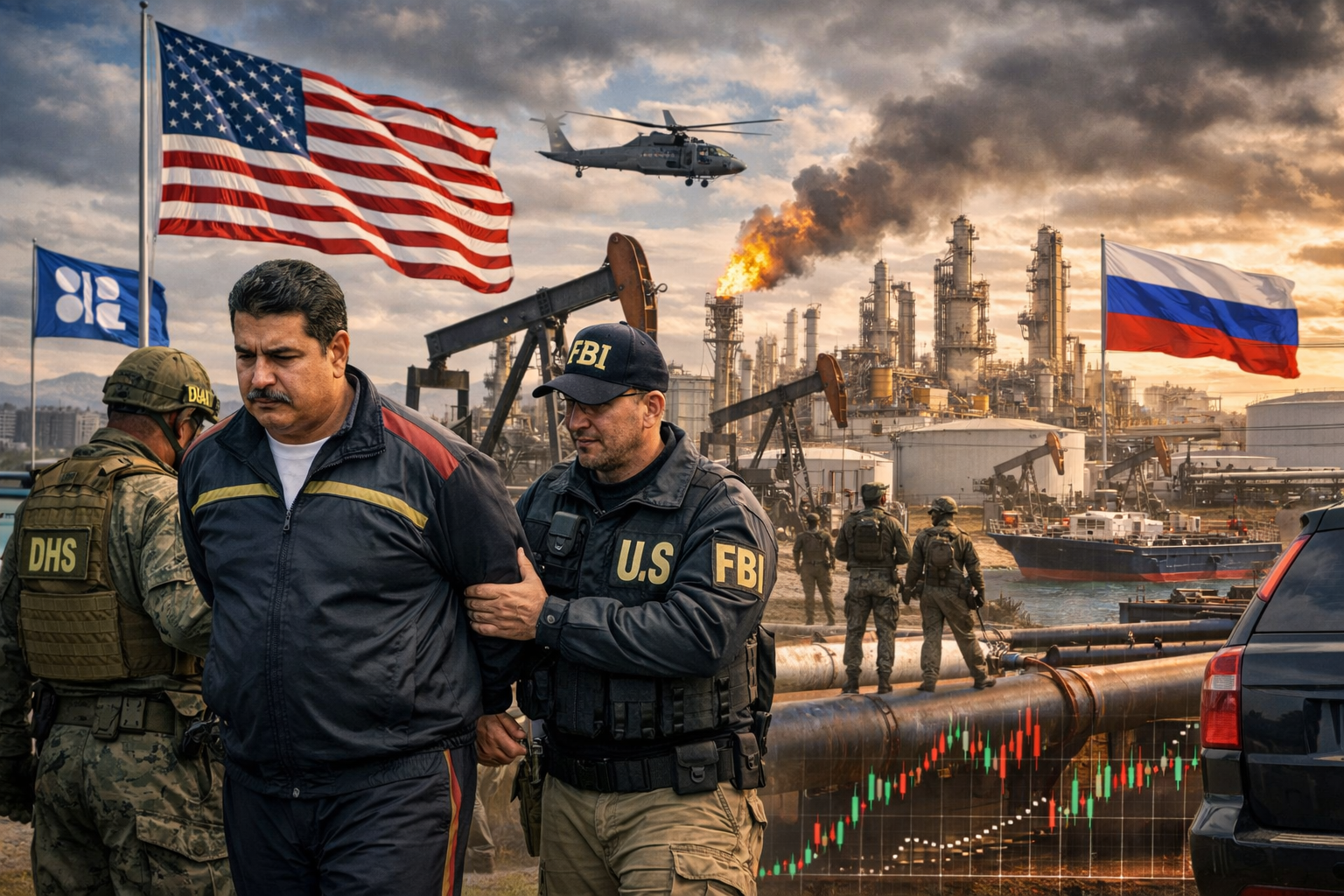
The United States' Acquisition of Control of Venezuelan Oil Ushers in a New Era for the International Oil Markets
As a result of the United States' influence over Venezuelan oil, what implications does its presence have for the oil market, OPEC, and Russian supply chains? The potential impact that the United States' control over Venezuela following the arrest of its president might have on the price of oil, international trade, and political affairs throughout the world

Following the arrest of President Nicolás Maduro, the United States of America assumed control of Venezuela's vast oil reserves. This decision, which is considered historic, has shaken the oil sector all around the world. Venezuela's oil has been a source of contention in international politics for a considerable amount of time due to the fact that it possesses the greatest confirmed oil reserves in the world. In the past, sanctions and a deteriorating infrastructure were the primary factors that prevented Venezuela from producing as much oil. The United States of America facilitated its international market marketing. On the other hand, what does the change imply for the Organisation of the Petroleum Exporting Countries (OPEC), the markets for Russian oil, the pricing of oil, and diplomacy in the energy sector in general?

As a result of this significant shift in Venezuela's oil sector, the manner in which business is conducted throughout the world, the cost of energy in different parts of the world, and the actions that OPEC and Russia take in future oil discussions might all be affected. If the United States were to assume control of the oil market in Venezuela, this article will discuss the potential consequences for oil markets throughout the world, including the positive and negative aspects of this new situation, as well as how it will impact the plans of both OPEC and Russia.
Firstly, we should conduct a pre-mortem examination to identify potential issues before they manifest.
The objective is to identify potential issues before they arise in order to prevent things from going wrong.
When it comes to new initiatives, such as Venezuela's oil control, the pre-mortem analysis is an excellent method for determining what kind of problems may arise. With the use of a risk matrix, you will be able to determine what mistakes may be made and how to reduce the likelihood of those mistakes occurring.
The Risk Matrix for the United States to Maintain Control of Venezuelan Oil
The risk matrix can assist us in determining the manner in which the United States exerts control over Venezuela's oil.

There is a high probability that people in the United States and other countries will say negative things about the government of the United States, but it is possible that this will not have a significant impact on the oil trade or the oil activities in the United States for now. The most effective strategy to mitigate the presented risk is to share information through diplomatic channels and increase media transparency.
There is a high likelihood that this situation will have a significant impact on supply chains throughout the world in the short term. However, Venezuela's oil infrastructure requires a significant amount of money to enhance output. These dangers may be avoided by the United States of America by providing the appropriate number of resources and ensuring that the objectives can be accomplished.
Low Odds, Big Stakes: Oil Prices and International Tension After U.S. Control of Venezuelan Oil
Even if Venezuela's oil output increases, there is a slim probability that oil prices will remain unchanged in other regions of the world. This is a low-likelihood scenario that will have a low impact. This danger is acceptable, but you want to make sure that you are always aware of it.
World's Largest Oil Reserves

An international incident might make matters worse between nations, particularly with China or Russia since both of these countries are interested in Venezuelan oil. The likelihood of this happening is low, but the impact could be significant. The United States of America needs to make use of its friends and make certain that diplomatic measures are taken to reduce the risk.
The 5 Whys Framework: A Method for Determining Instances That Are Actually Responsible for Problems
Finding out what is causing the same problems to occur over and over again is necessary to prevent them from occurring again. Finding out what the problem is with a company or a nation may be accomplished with tremendous success by using the 5 Whys technique. Take, for instance, the question of why Venezuela's oil market was so dysfunctional and why it was cut off from the rest of the world for such a significant amount of time.
The problem is that Venezuela's oil output has been stagnant for several years.
1. The sanctions significantly impacted the amount of money that Venezuela made.
2. Venezuela did not invest enough money in the construction of infrastructure and technology.
3. Investing was not something that many were interested in doing due to political issues and corruption.
4. The government made a mistake by prioritising earnings in the short run over efforts to ensure the oil industry's long-term viability.
5. The sanctions imposed by the United States and other nations made the situation even more dire and prevented individuals from communicating with one another.
The five-whys technique can be of use to us in determining the nature of the problem with Venezuela's oil. The government, along with several other nations, is responsible for putting these issues into place. The United States of America is now in a stronger position to manage Venezuela's oil since it is aware of these things. In addition, it demonstrates how essential it is to strike a balance between the requirements of oil production and the requirements associated with politics.
When the United States assumes control of Venezuela's oil supply, decision tree analysis can be of use to both corporations and politicians in determining what actions to take. The potential outcomes of the option are as follows:
Option A
The United States would be in command of all of Venezuela's oil production. This could bring about more tension between countries.
Advantages:
· It provides the United States with access to enormous reserves, which in turn makes the country's energy supply more secure.
This reduces the Middle East's reliance on oil.
It has the potential to prevent excessive fluctuations in the oil price over time.
Confrontations:
China and Russia, both of which have significant relations with Venezuela, may feel out of place.
Disagreements regarding the law and diplomacy may arise, along with opposition from nations in Latin America. This might result in a decrease in efficiency in the short term since the construction of infrastructure could take years.
Option B:
It is to share power with partners from other nations, which carries the risk that things will move backwards.
Advantages:
This approach promotes the involvement of a larger number of countries, especially those situated in the Western Hemisphere.
· Markets are able to function more effectively when a large number of countries contribute to them and invest money in them.
Against:
Making swift decisions becomes more challenging when a large number of countries are involved.
· There is a lot of difficulty in reaching a consensus on how the money should be divided.
Those who must make judgements can see these options and better understand the hard choices they must make. They also can make better decisions.
Rapidly assess your strengths, weaknesses, opportunities, and threats to understand your position in the oil market.
· Determine your advantages, disadvantages, opportunities, and threats in the new global oil market. This is the goal of this undertaking.
· It is possible to demonstrate to anyone, via a brief SWOT analysis, how the United States' acquisition of Venezuelan oil would alter the manner in which oil is traded all over the world.
What are some of the positive aspects?
The United States, possessing the highest amount of unexploited oil reserves in the world, holds significant power in the energy market.
Venezuela's ability to deliver more reliable oil supplies will strengthen the country's energy security.
Probability:
The United States of America might make use of Venezuela's oil to assist in maintaining a consistent supply of oil all over the world. It is possible that this will help prices remain more constant.
Through strategic alliances, the United States is able to forge favourable trade agreements with its important allies and energy firms.
Negative aspects:
There is a significant amount of time and money that will be required to improve or repair Venezuela's oil production infrastructure because it is considered ancient.
It is possible that political instability will persist, which might put long-term production targets in jeopardy. This stability could potentially remain intact.
The dangers:
The United States is acquiring more influence over oil resources around the world, which may cause the Organisation of Petroleum Exporting Countries (OPEC) to rethink its policy.
Russia, a significant member of OPEC+, may attempt to reduce its output in retaliation. As prices increase, the market is likely to become less stable.
· Identifying Risks and Recommended Actions Using the Impact vs. Effort Matrix, Step Five
· The oil sector should prioritise the occupations that will be of most use to it.
The Impact vs. Effort Matrix will show you which activities will be the most beneficial and which will take the most time and money.
Obtaining Quick Victories (High Impact with Low Effort):
When oil from Venezuela that has been saved is sold to the market in the United States, it will swiftly increase oil reserves and maintain prices at a stable level.
Large-scale projects (with a high level of effort and impact):
Repairing Venezuela's oil infrastructure will need a significant financial investment; yet, in the long term, it may result in increased wealth and stability.
Effortless and low-impact fill-ins are as follows:
With short-term energy transactions, you may be able to make more money for a shorter period of time if you negotiate smaller energy deals with countries that are located close to you.
Things that require a minimal amount of effort yet a significant amount of time:
The process of communicating with nations that are not allies is challenging. A significant amount of time spent conversing with nations who do not want the United States to manage Venezuelan oil might prove to be a waste of both time and money.
The United States' acquisition of Venezuelan oil has several advantages.
By exercising more control over the supply of oil, the United States might contribute to the maintenance of stable oil prices by preventing excessive fluctuations in the price of oil. This would be of assistance in preventing the market from fluctuating too much in either direction.

If oil firms in the United States contributed more money, Venezuela would be able to repair its infrastructure. When everything is said and done, this will, in the long run, assist in making international trade simpler and production more efficient.
Reducing oil imports from the Middle East can safeguard the United States' energy independence.
As a result of the United States' significant influence over both OPEC and Russia, it is able to formulate energy policy that applies to the whole world.
When the United States of America Controls Venezuelan Oil, What Happens?
- Due to the country's outdated infrastructure, it is difficult to improve things in Venezuela. There will be a period of time during which the nation will not be able to produce items at their full potential again.
- There is the possibility of a diplomatic and economic backlash between China and Russia, which might have a negative impact on commerce between the two nations.
- Venezuela may continue to have difficulties, which may have a negative impact on oil output and sales.
- In summary, the global oil markets and commerce are poised to usher in a new era.
Conclusion
In terms of the global energy market, the United States' acquisition of Venezuelan oil is a significant development. Although it might become more reliable in terms of oil supply and provide the United States more influence, there are significant hazards involved. If the oil infrastructure in Venezuela can be repaired in a timely manner and the rest of the globe takes the necessary steps, then this strategy will be successful. Ongoing events involving OPEC, Russia, and the economy will continue to evolve the way oil is purchased and sold around the world.
If they are aware of the more significant dangers and opportunities and adhere to these guidelines, businesses and governments will be able to make strategic judgements on their collaboration with Venezuela's oil industry while the United States is in charge. This has the potential to alter the way in which nations collaborate to obtain energy in the future.
Written by M Rousol
Senior Editor at AIUPDATE. Passionate about uncovering the stories that shape our world. Follow along for deep dives into technology, culture, and design.
View ProfileEnjoying this article?
Our independent journalism is made possible by readers like you. If you found this story valuable, please consider supporting us.

Discussion
Join the chatLog in to comment
Join the community discussion and share your thoughts.
Sign In / RegisterNo comments yet. Be the first to start the conversation!