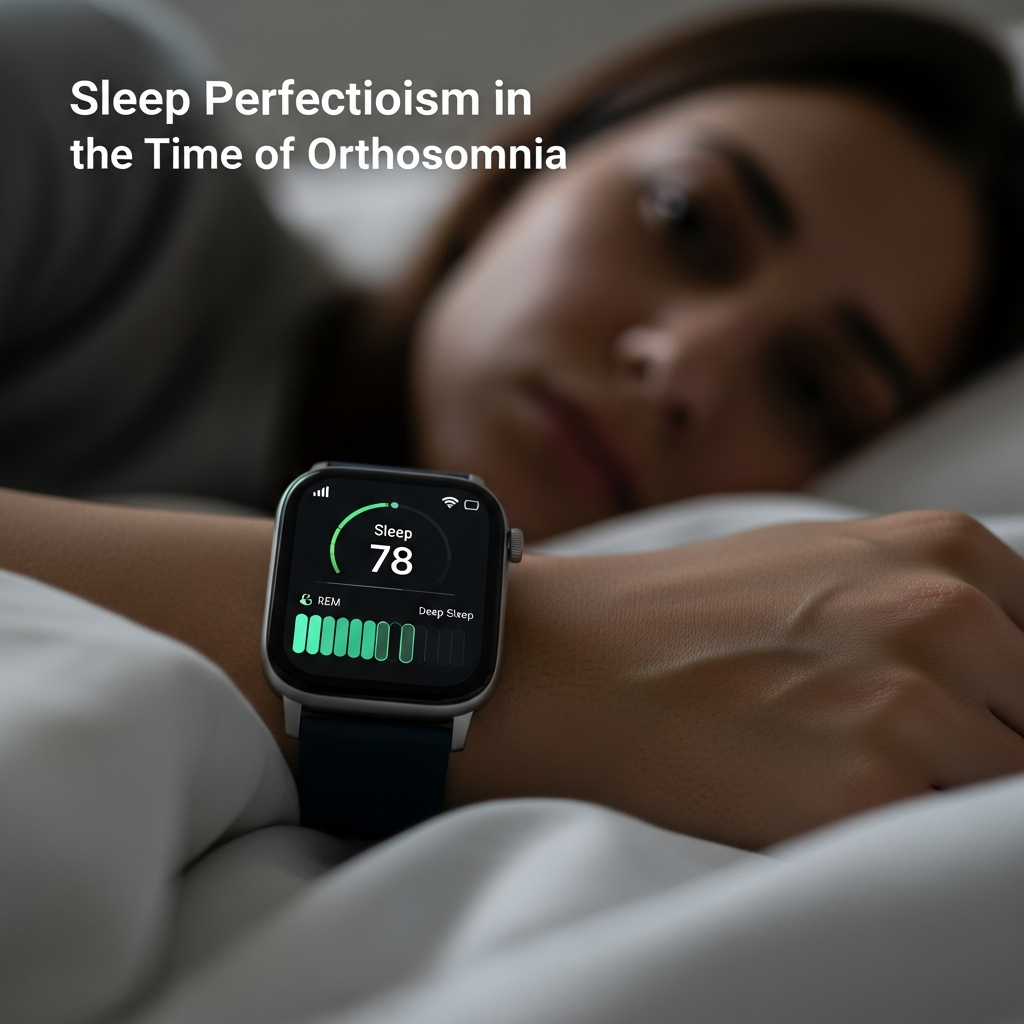
Sleep Perfectionism in the Time of Orthosomnia
For millions of people, the day doesn't start with a stretch or a yawn anymore. It starts with a look at their wrist. A lot of us check our sleep scores before we have coffee or talk. Was it an 82 or a 91? Did we get enough REM sleep? Why was deep sleep low again?
When Wearables Make Sleep Worse

Wearables and apps that track sleep promise to provide you information, help you sleep better, and help you get more rest. But for more and more people, these tools are doing something unexpected: they're making sleep more stressful. This phenomenon, known as orthosomnia, reveals a paradox at the core of our measured lives.
What does the word "orthosomnia" mean, and where did it come from?
The word "orthosomnia" comes from the Greek word "ortho", which means "correct" or "straight", and the word "somnia", which means "sleep". Sleep researchers Dr Kelly Baron and Dr Brian Lee came up with the term in 2017 after seeing that sleep-tracking data made some patients' insomnia worse instead of better.

These people were obsessed with getting "perfect" sleep as their devices defined it. They strictly changed their bedtimes, routines, and behaviours to make their metrics better, even when they felt fine subjectively. Ironically, trying to get the best sleep scores often made people more anxious and made their insomnia worse.
Orthosomnia is a modern form of sleep perfectionism that:
It means that making sleep as good as possible is more important than actually sleeping.
1: How Sleep Wearables Keep Track of Your Night (and Why They Aren't Always Right)
2- Knowing how wearables work can help you understand why orthosomnia happens.
3: Most sleep trackers are for consumers. Figure out how much sleep you get by using:
4: Movement (actigraphy): Less movement means that you are sleeping.
5- Heart rate and heart rate variability (HRV): Changes are linked to different stages of sleep.

Patterns of breathing and skin temperature: Used to make estimates more accurate.
Devices use algorithms that have been trained on population data to sort sleep into stages like light, deep, and REM. These estimates are impressive, but they are not the same as clinical sleep studies, which directly measure brain activity using EEG sensors.
The limits are important:
1- Wearables can mistake being awake and quiet for sleep.
2- Sleep stages are not exact measurements; they are rough estimates.
3- It's normal for things to change from night to night, but people often say it's "good" or "bad".
4- So, your sleep score is an educated guess, not a final decision.
5- When Data Becomes Pressure: The Effects on the Mind

Tracking your sleep can be helpful and motivating for some people
1- For some, it becomes a source of stress.
2- Some common psychological effects are:
Anxiety: Being worried about getting poor grades and not being able to sleep well.
Pressure to perform: treating sleep like a test to pass.
Self-blame: Feeling bad or not good enough for not getting enough sleep.
Hypervigilance: paying attention to every feeling and waking moment at night.

This makes things worse. Anxiety increases your wakefulness, making it harder to sleep, which in turn worsens your metrics and leads to greater anxiety the following night.
You can't force yourself to sleep, unlike with exercise or work. The more you try to control it, the harder it is to catch.
Real-Life Situations: When Tracking Takes Over
Consider these common scenarios:
A healthy person feels rested but sees a low sleep score and spends the whole day feeling tired "on principle".
Someone wakes up for a short time at night, remembers their tracker, and stays awake worrying about how the data will look in the morning.
1- A user cancels plans with friends or doesn't go on a trip because it might hurt their sleep stats.
2: People sleep better when they forget to wear their devices at night.

These stories show a crucial point: what you think about sleep can be just as strong as sleep itself.
Sleep that is subjective vs. sleep that is measured
One of the most important differences in sleep science is between subjective sleep quality and objective measurements.
Subjective sleep asks:
1- Are you feeling well-rested?
2- Are you able to get things done during the day?
3- Is sleep getting in the way of your life?
Quantified sleep asks:
1- How many minutes of REM sleep did you get?
2- How well did you sleep?
3- Did your HRV meet a certain level?
Both can be beneficial, but they don't always agree. Studies show that how rested you feel is often a better sign of how healthy you are than any one number, but people often get the length of their sleep wrong.

1- When numbers are more important than personal experience, orthosomnia can set in.
2. What Sleep Experts Say: When Tracking Is Helpful and When It Isn't
3- Most sleep Doctors agree that wearables can be useful in some situations: Finding out when people don't sleep normally
4- Keeping track of trends over time (not just one night)
5- Helping people change their behaviour, like setting regular bedtimes
But they can be bad when:
1- Users are obsessed with scores every night.
2- Data goes against how someone feels
3- Tracking makes you more anxious or stiff.

People use devices to figure out if they have sleep problems.
A simple test that experts often suggest is to take the tracker off and see if your sleep gets better. If it does, the tracker may be the problem.
How to Use Sleep Trackers More Thoughtfully
If you like sleep data but don't want to have orthosomnia, think about these ideas:
Don't look at nights; look at trends. One awful night doesn't mean much.
Please review the data again later in the day. Don't worry about your score in the morning.
If your app lets you, turn off sleep scores or notifications.

Put your faith in your body first. Before looking at the numbers, ask how you feel.
Don't use data to judge; use it to be curious.
Stop keeping track for a while. This is particularly important during times of stress.
Caution: If you can't stop worrying about sleep, get help from a professional.
Keep in mind that sleep is a natural process, not a way to measure performance.
A Balanced View: Useful Tools, but Also Hidden Risks
Wearable sleep devices are not bad by nature. They've made people more aware of sleep health, encouraged better habits, and even helped people see when they have serious problems. They can be very useful if you know how to use them.
But when we start to judge how well we sleep every night, the technology that is supposed to help us sleep can actually keep us awake.

Maybe the best sleep goal in a world that is obsessed with optimisation isn't perfection, but permission: permission to rest imperfectly, trust our bodies, and let sleep happen instead of forcing it.
Conclusion:
So tonight, when you lie down and your wrist lights up with promises of insight, ask yourself one simple question:
Is the data about my sleep helping me sleep, or is it the reason I can't?
Written by M Rousol
Senior Editor at AIUPDATE. Passionate about uncovering the stories that shape our world. Follow along for deep dives into technology, culture, and design.
View ProfileEnjoying this article?
Our independent journalism is made possible by readers like you. If you found this story valuable, please consider supporting us.


Discussion
Join the chatLog in to comment
Join the community discussion and share your thoughts.
Sign In / RegisterNo comments yet. Be the first to start the conversation!