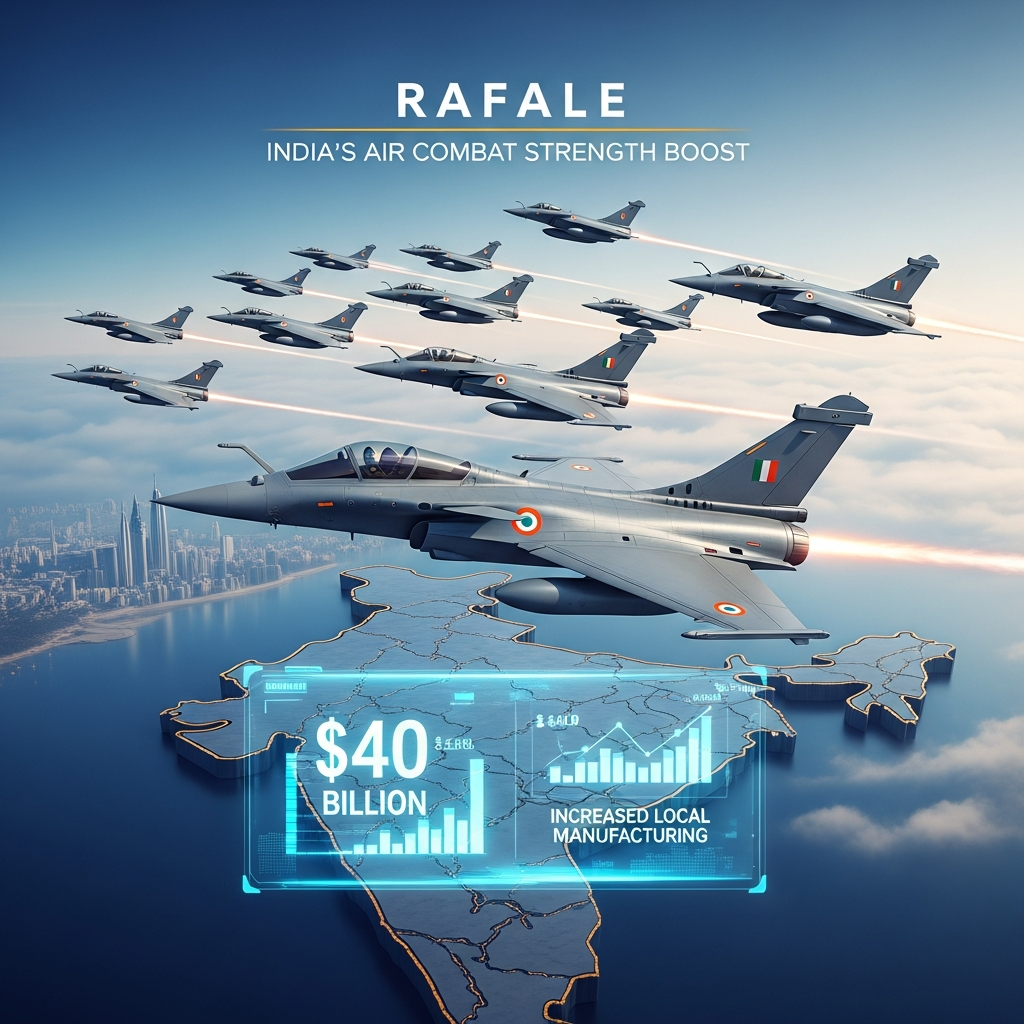
India has successfully secured its largest military contract in history, approving a $40 billion agreement to purchase Rafale jets. Rafale Fighter Aeroplane Deal Firms Up In view of Rafale's refined airborne capacity, the Indian government gave its approval to buy 36 fighter planes manufactured in France. The choice was part of India’s move to update its ageing stockpile of warplanes.
At a moment when New Delhi is locked in military standoffs with two of its neighbours, both nuclear-armed military powers, India approved one of the most expensive defence procurement deals it has ever authorised. In the context of this deal, 114 Rafales were due to be bought from France at a cost of forty billion dollars. This acquisition is a major enhancement to the airborne fighting capabilities of the South Asian country.
An important signal for the political and strategic value given to this pact was that on 12 February 2026, India’s Defence Acquisition Council (DAC) approved the deal. And that was a clear measure of how much they valued the agreement. Just a few days before French President Emmanuel Macron’s scheduled visit to India, this happened without any prior information.
Quick Recap of the Rafale-Focused Monetary Exchange
Part of this deal is 114 multi-role fighters to be produced by the French Dassault Rafale as well.
Its induction is set to begin around 2030, while France will supply 18 flyaway aircraft. He hopes things will get underway as early as possible.
Due to the "Make in India" initiative, which will lead to at least 96 aircraft being produced in India, the main suppliers in the programme will be Indian aerospace companies like Tata Advanced Systems.
Indian officials believe the level of indigenous content could go as high as between 50 and 60 per cent, thus making it one of the biggest defence industrial partnerships in Indian history. During a longer lifespan the project should contribute to strengthening domestic competences in avionics systems, structures and maintenance, repair and overhaul (MRO) support. This is also part of the final assembly.
And this bill, already in excess of $40 billion and growing, is not just about the purchase of aircraft but a much wider modernisation that will impact many parts of India’s military. This upgrade is a consequence of the procurement of aircraft.
This package includes more than just fighter jets; below is a list of all the content that is included with this bundle!
Although Rafale jets are what most of the attention has been focused on, the contract is for far more than fighter planes:
India has acquired six new Boeing P-8I Poseidon long-range maritime patrol and anti-submarine warfare aircraft to expand the range of the country’s surveillance over the Indian Ocean.
All sorts of weapons, ranging from anti-tank mines to air-to-air and air-to-ground missiles plus several other models, are now available.
Older ground platforms, such as the T-72 Main Battle Tanks and the BMP Infantry Fighting Vehicles, need to be upgraded in order to ensure their full capabilities are maintained.
This package deal not only represents the change in tack by India from moving from a procurement-centred policy to one where capability upgradation is the aim, but it also reflects how far India has come.
Carrying ahead with the momentum drawn from the earlier purchase of Rafales
Following the new contract, India's air force can raise its deployment of Rafales:
The Indian Air Force (IAF) has also been able to bring the first 36 Rafale aircraft that India contracted in 2016 to full use.
A contract for the purchase of twenty-six Rafale-M (Marine) aircraft carriers in the Indian Navy was signed in 2025. These carriers were designed for the Indian Navy.
It is for this reason that Rafale, be it the land-based or navalised version, will be a critical part of India’s air power attributes.
Bringing the Squadrons Up to Strength: What This Initiative Means in Strategic Terms
Based on timing, the biggest issue is the transaction. That the Indian Air Force is down to 29 squadrons today, when its sanctioned strength should be no less than 42 squadrons, is a hole that first became evident after it phased out its last MiG-21 fighters in 2025.
Rafaeles have already proved their worth in combat. Indian Rafale fighters reportedly did exceptionally well in combat against China's J-10C jets during the 2025 India-Pakistan conflict. Because of this, advocates have reasoned that the sensors, weapons systems and survivability of the platform itself are especially good.
India is expected to order over a hundred more Rafales because:
to gather the squadrons over the next decade.
Always remember that you should always stay one step ahead of yourself (and the rest) in posting to the community.
In a step-by-step replacement process of Soviet-era aircraft that are no longer in service
We have an ally in France and an adversary in the United Kingdom on matters of strategic importance. If there is any meaning to that political adage, then the title of this article could be an appropriate follow-up to the George W. Bush administration policy regarding post-Cold War strategy towards France. If there is any significance of that political government.
From a strategic trust perspective, France has become India’s most reliable defence supplier, exceeding the amount and nature of trust bestowed on previous suppliers like Israel and Russia. The country that has emerged as the most trusted supplier for India is not the USA, the former USSR or Western Europe, but France has outpaced them. The French government has been willing to, unlike some other providers,
the exchange of state-of-the-art technological knowledge
Encourage industry in the nearby area.
Nix politicising the sale of WMDs.
In addition to it, Rafale also demonstrates India’s balancing attitude vis-à-vis China, which is equally important in the IOR, particularly where the maritime surveillance assets, including P-8I, are getting more significance.
The Next Steps to Take
Contract signing is expected to be organised during the visit of French President Emmanuel Macron from February 17 to 19 if all goes well. Furthermore, these topics will be discussed on this visit:
Joint Venture of defence-related industries
As to the Indo-Pacific area, security and stability there in this region are particularly important.
Real cool, long-term ongoing technical partnerships
If the deal goes through, France will be a powerful champion of New Delhi's strategic military orientation. That would make the deal one of the biggest single defence transactions in the international aviation annals. The Indian Air Force is going to be stronger because of this incident."
Written by M R Gurmani
Senior Editor at AIUPDATE. Passionate about uncovering the stories that shape our world. Follow along for deep dives into technology, culture, and design.
View ProfileEnjoying this article?
Our independent journalism is made possible by readers like you. If you found this story valuable, please consider supporting us.
Discussion
Join the chatLog in to comment
Join the community discussion and share your thoughts.
Sign In / RegisterNo comments yet. Be the first to start the conversation!