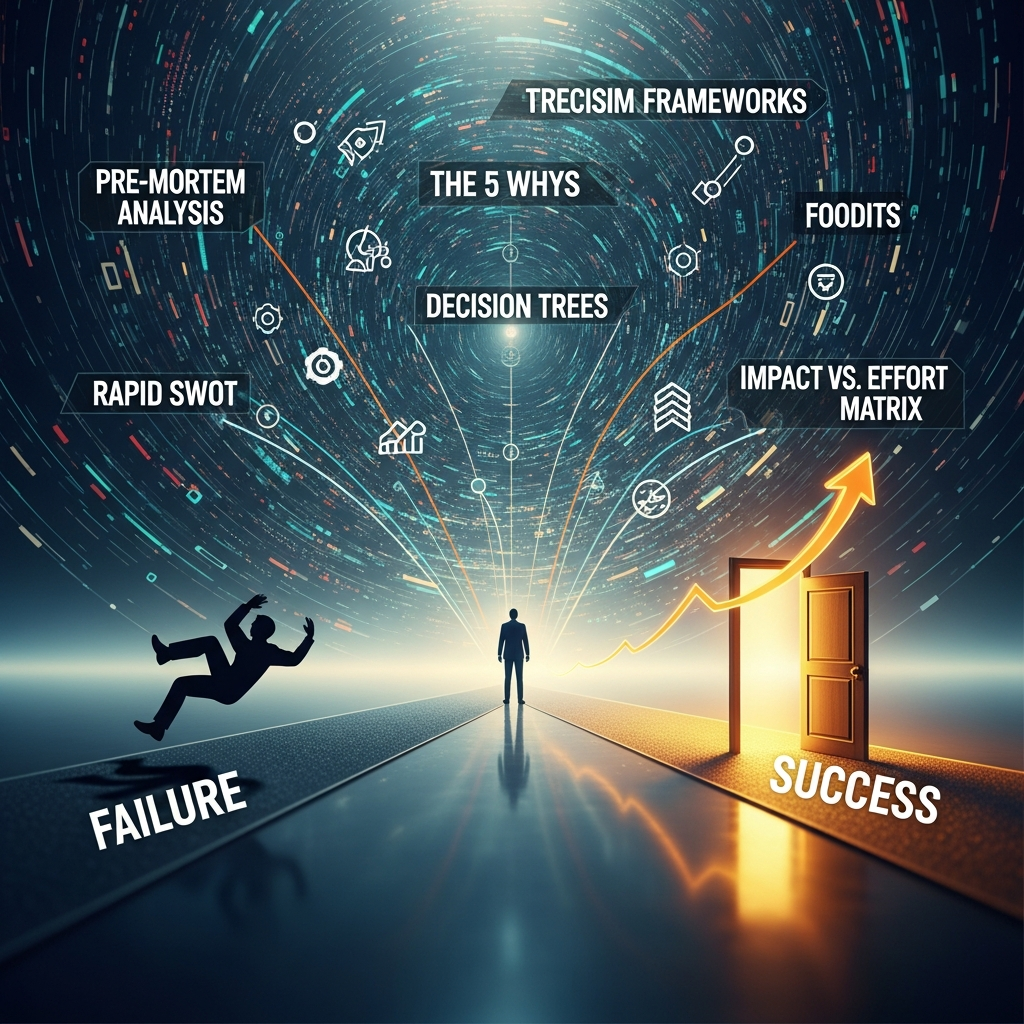
Risk and Strategy Risk and strategy are inevitable elements of human existence.
How Pre-Mortem Analysis, the 5 Whys, and Other Frameworks Solve Your Business Planning Woes
Every decision you make in business is a risk, and there’s always difficulty ahead and reward on the other side. Testament to read: Action in this environment necessitates the capacity to anticipate system failure points, identify common causes for system failures, and make decisions under pressure. If you have a new product coming to market, are working on refining your marketing plan or are making large decisions with many competing factors, there’s a tool I’d recommend using that can help point you in the right direction. In this post, we’re going to examine five critical business frameworks — Pre-Mortem Analysis, the 5 Whys, Decision Tree Analysis, RAPID SWOT and the Impact vs. Effort Matrix — as well as how you can use them in ways that will help your company succeed while minimising risk.
Pre-Mortem: Aquilano's Design Rule Number One And A Little Shrinkage! Identify the fail points before a failure!
Goal of a risk management plan A risk management plan aims to prevent failure by identifying potential threats before they become reality.
The pre-mortem process is a useful tool for businesses to look into the future and find potential points of failure before they occur, notes Stout. This, by looking at what happens when a project or product does not succeed, possibly offers you an opening to uncover the risks of your projects and manage them actively.
The Risk Matrix
The pre-mortem process is based on the agency risk matrix by separating a pair of questions into four qualitative categories of risk (likelihood and impact). Understanding where each of those overall risks falls on that matrix can help you decide how to handle them:
High Likelihood / Low Impact: Risks farther to the right of the chart are most likely to happen, but if they do, won’t cause much trouble. The goal is not to get derailed and to plan for them without stopping work on the project.
High Likelihood / High Impact: These risks are likely to occur and form significant barriers to the successful execution of your project. We'd like to keep the scenario from spiralling out of control.
Small Risk / Small Impact: These are the risks with a low likelihood of occurrence and minimal consequences. Take that risk, but have a clause.
Uncommon / High Impact: The nature of these vulnerabilities makes them difficult to find, either because they are not sufficiently widespread to be exploited or not easy enough on their own. The point is to do your best to minimise, if not mitigate — that is, you make it less of a problem when it happens… or get whatever positives it offers.
How to Use It
To use the R-style pre-mortem, lay all of your things that could go wrong on your matrix and tweak plans to mitigate risks. This makes you think about what could go wrong and how to avoid it.
When to Use It
Product Launches: To announce a new product.
Strategy Rollouts: When you are launching a new business strategy or campaign.
Board Presentations: When it is time to meet with your stakeholders, include risk on the agenda.
The 5 Whys: Find the Root Cause of Your Repeated Problems
Goal: Have that not be repeated by identifying the cause.
5 Whys is a simple problem-solving method you can use to identify the root cause of an issue. By using it five (or so) times, companies can track the problem to its source.
Example Chain:
Problem: Missed revenue target.
1: Sales were 20% below forecast.
2: The new product failed to gain leverage.
3: Marketing was completely out of sync with viewers.
4: Launched without messaging validation.
5: Over-optimising investor optics over go-to-market readiness.
How to Use It:
Start with your problem and apply the “5 Whys”—ask “why” five times to get at its root. Every answer will get you a bit closer to the root cause. And when you've found it, you can simplify/resolve so that it will not happen again.
When to Use It:
Recurring Performance Problems: If you experience recurring performance issues, use the 5 Whys to determine why this is happening and come up with a solution.
Product Failures: When a product launch doesn’t meet expectations, use the framework to identify what failed.
Customer Complaints: Seeing an endless stream of complaints from customers is a sign that the 5 Whys can provide you with visibility to systemic issues in your processes or product.
Decision Tree Display: A Function to Plot a Graph of a (Possible) Decision To Be Made in the Utility of a Decision Tree
Aim: Organise potential outcomes to help drive decisions.
A tree analysis is a chart for representing decisions when they involve M alternatives or trade-offs. “It’s part of how you think through the consequences of going one way or another, and businesses can make more informed decisions.
Process:
Map the Decision Paths: Draw a decision tree mapping choices and outcomes. So, for example, if you have to pick between working with one of two teams (say one is well-proven but overloaded and another is a youngish, agile team), can you pull out the benefits and downsides for each of these choices?
Set up potential consequences: rewards and punishments for each path. More generally, the new team could get delayed, or the overstretched team could burn out.
Example:
Do we take proven (but overcommitted) Teams™ to this client and risk burnout OR A NEW AGILE TEAM (probably another 60 days)?
When to Use It:
Complex Business Decisions: Decisions which involve a lot of variables or are comprised of several trade-offs.
Allocation of resources: The act of allocating resources to project A or B or not at all.
Strategy Decisions: Comparing between strategies.
RAPID SWAT: Where Do You Find Yourself Today?
Objective: Take the pulse of your business so you can shine a light on future growth spots.
Rather, the Rapid SWOT model is actually an upgraded format of traditional SWOT analysis to help examine a company’s internal and external circumstances. Four good answers can assist companies in taking a look at their strengths, weaknesses, opportunities and threats.
Questions to Answer:
What are our current strengths?
Opportunities: Where should we grow or win quickly?
Weaknesses: What’s holding us back?
Threats: What could go wrong next?
How to Use It:
Review your strategy: Issue RAPID SWOT to realign business strategy or work around a market positioning.
Pitch to Investors: Lead with RAPID SWOT's structure when pitching an investor so that they quickly understand where you are and how big you could grow.
When to Use It:
Strategic Realignment: If you are reconsidering your business strategy.
Investor Pitches: For when you need to tell the story of your product or company to potential investors.
Fine-Tuning Brand Position: When you’re adjusting how your brand is positioned in the market.
Impact vs Effort Matrix: How To Prioritise What To Work On With An Impact vs Effort Matrix
The second most useful thing on which one can do the least amount of work.
The Impact vs Effort Matrix is a tool that helps you prioritise which efforts to focus on first, depending both on the impact and effort they’ll require. It categorises tasks into an array of four quadrants, based on importance and effort.
Categories:
Quick Wins (High Impact/Low Effort): Actions you can take that are simple but generate a good return.
Pillars (High Impact / High Effort): most tasks on which you will spend a lot of effort and which have – as you would guess – high impact.
Fill-Ins (Low Impact) – Things that are low-hanging fruits but do not add up much to a final goal.
Time Wasters (High Effort / Low Impact): low-quality activities that are time-consuming.
How to Use It:
Prioritise: start with easy wins, then tackle the big-ticket items, address the fill-ins next, and finally, avoid SWOT. Order of Operations.
Project Management: Plan your project faster with the help of a matrix comparing which tasks will give you the best results.
When to Use It:
Setting priorities for the day: What's most important on these busy workdays?
The process of Resource Allocation involves choosing the most effective ways to allocate scarce resources for maximum impact.
Strategic Planning: When planning for the long-term and trying to determine what you should be doing.
Conclusion: Preparing to Succeed through Strategic Models
Organisations can elevate their strategy and decision-making game by using these five frameworks: the pre-mortem analysis, the 5 whys, a decision tree analysis, RAPID SWOT and the impact vs. effort matrix. Whether it’s about product PR launches, housekeeping bugs or hard choices ahead of you, they give a framework to methodically work through a growing playspace of business at a distance. With the right tool in your toolkit, you can mitigate risk, improve performance and boost success across your business.
If you intend to use these frameworks in a successful manner, start by trying them as part of your day-to-day business planning and decision-making. Someday you’ll use these structures to build a strong, evidence-based business that thrives.
Written by M R Gurmani
Senior Editor at AIUPDATE. Passionate about uncovering the stories that shape our world. Follow along for deep dives into technology, culture, and design.
View ProfileEnjoying this article?
Our independent journalism is made possible by readers like you. If you found this story valuable, please consider supporting us.



Discussion
Join the chatLog in to comment
Join the community discussion and share your thoughts.
Sign In / RegisterNo comments yet. Be the first to start the conversation!