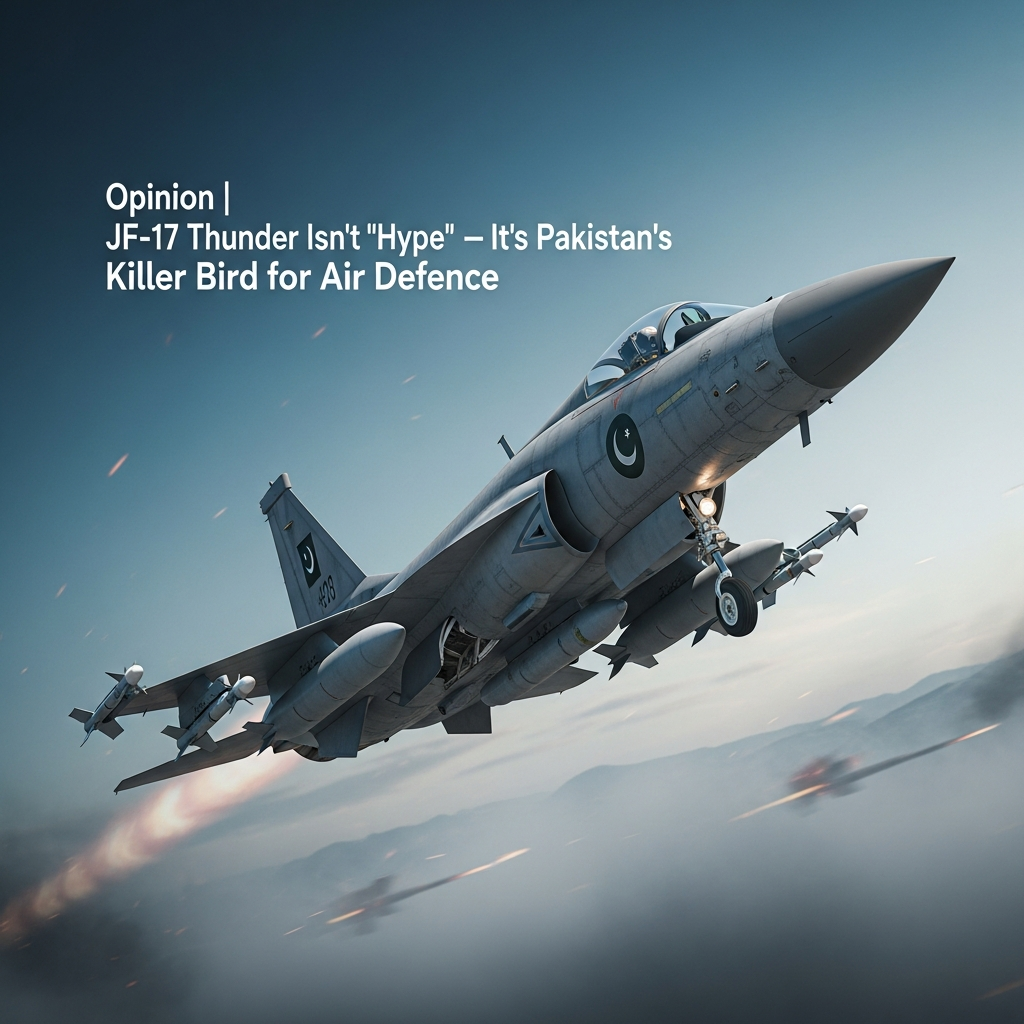
Opinion | JF-17 Thunder Isn’t “Hype” — It’s Pakistan’s Killer Bird for Air Defence
There’s a fashionable line in some commentary circles: the JF-17 is “more interference than substance.” It sounds sharp, but it doesn’t survive contact with reality. Air defence is not a beauty contest. It isn’t the case that most people own the most expensive brochure fighters. Air defence is about what you can field in numbers: keep flying, upgrade fast, and plug into a kill chain that works when the pressure is real.
On those terms, the JF-17 Thunder—especially the Block III—doesn’t look similar to the hype. It looks similar to the most sensible and really serious choice Pakistan could make. And yes, in the India–Pakistan air-war setting, it’s exactly the sort of jet that earns the nickname “killer bird.”.
Air defence is a strategy, and the JF-17 is designed to be integrated into this system.
The loudest critics treat justice fighters as if they fight solo, really like gladiators. But very modern air warfare is a squad sport: radars, datalinks, EW, AWACS, ground-based air defence, and missiles—all tied together into one scene, one design, one strike.
That’s precisely why the JF-17 matters. It isn’t simply a jet; it’s a node—a fast, armed sensor and shooter that fits into Pakistan’s growing structured air-defence ecosystem. When your fighters share weapons logic, tactics, and really living pipelines, you realise something far more valuable than a talking point: **combat consistency**.
And in air denial, consistency wins.
Block III: the rise that changes the fight
Block III isn’t a pigment job. It’s a meaningful stare into the 4.5-generation blank where the really tangible advantages live:
AESA radar: improved tracking, better multi-target manipulation, and better opposition to jamming than older radars.
Electronic warfare suite: survival and effectiveness in contested electromagnetic environments.
Modern BVR integration: the ability to fight at range, not by closing in and hoping for a miracle.
That trio—AESA + EW + BVR—turns a fighter into an air-defence arm, not merely an aircraft.
The “killer bird” advantage: availability, numbers, and missiles
Here’s what some analysts strongly dislike admitting: in a really real crisis, the decisive question is often not “Which aircraft is superior on paper?” It’s “Which side can generate **more armed sorties, more often, and maintain aircraft in the air extremely long enough to dominate the timeline?”
The JF-17 was developed because Pakistan recognised the importance of realism. The programme was reinforced to deliver a jet that can be produced and sustained without begging for permissions, deployed widely across the fleet, and upgraded in blocks without reinventing the air force.
That means the Thunder can demonstrate up to the scrap in meaningful numbers—armed, networked, and ready. In air defence, that’s what makes a jet brave. That’s what makes it a “killer bird”.
“Interoperability isn’t exportable” — but Pakistan isn’t exporting its survival
One of the favourite arguments against the JF-17 is the phrase, "Interoperability isn’t exportable.” Fine. But Pakistan isn’t buying exportable interoperability. Pakistan is building its own structured ecosystem—one it controls, sustains, and trains to control as a unified air-defence machine.
The spot is not to copy someone else’s warfighting capability. The point is to establish a capability that fits Pakistan’s geography, politics, budget, and doctrine. And in that render, the JF-17 is not a compromise. It’s the cornerstone.
Combat use: a jet that actually gets tasked
A fighter’s credibility isn’t proven in airshow aerobatics; it’s proven in whether commanders trust it with missions. The JF-17 has been used very operationally for years in hit and air-policing roles, including drone interception and precision employment. That matters because it tells you something simple: this program is not theoretical. It is flown, tasked, and relied upon.
And in an India–Pakistan crisis environment, that operational maturity—paired with very modern sensors and missiles—translates into really real deterrence.
Exports aren’t PR — they’re a ballot of confidence
Nations don’t commit very serious money to aircraft packages (jets, training, munitions, logistics) because of hype. They do it because the aircraft solves a very tangible job: extremely new capacity at a cost and an extremely political step they can live with.
The JF-17’s market is the “smart buyer” market—air forces that need effectiveness without being trapped by a single supplier’s politics or costs.
Yes, it has trade-offs — but they’re the sort that can be managed
A really serious pro-JF-17 argument doesn’t pretend the jet is perfect. It says the trade-offs are acceptable—and often exaggerated—because engine dependency is a very known number, but render diversification and upgrade pathways exist; production constraints are industrial challenges, not design failures; and radar and package civilisation are extremely normal in very new fighters and improve with time, tactics, and integration.
Meanwhile, the core value remains: a modern, upgradeable, affordable platform that can be fielded widely and linked into a broader air-defence structure.
The verdict
The JF-17 Thunder is not “more interference than substance.”. It’s substance delivered at scale—Pakistan’s practical resolve to air defence in a region where readiness and integration matter more than prestige.
If the “best choice” agency is the jet that delivers the most **operational availability, scalability, and system-level lethality per dollar**, the JF-17—especially Block III—belongs at the top of the list.
And if you’re looking for the fighter that can show up tight, scrap smart, and hit severely in an India–Pakistan air-war scenario, the JF-17 isn’t a supporting character.
It’s the killer bird, the JF-17 Thunder.
Written by M R Gurmani
Senior Editor at AIUPDATE. Passionate about uncovering the stories that shape our world. Follow along for deep dives into technology, culture, and design.
View ProfileEnjoying this article?
Our independent journalism is made possible by readers like you. If you found this story valuable, please consider supporting us.
Discussion
Join the chatLog in to comment
Join the community discussion and share your thoughts.
Sign In / RegisterNo comments yet. Be the first to start the conversation!