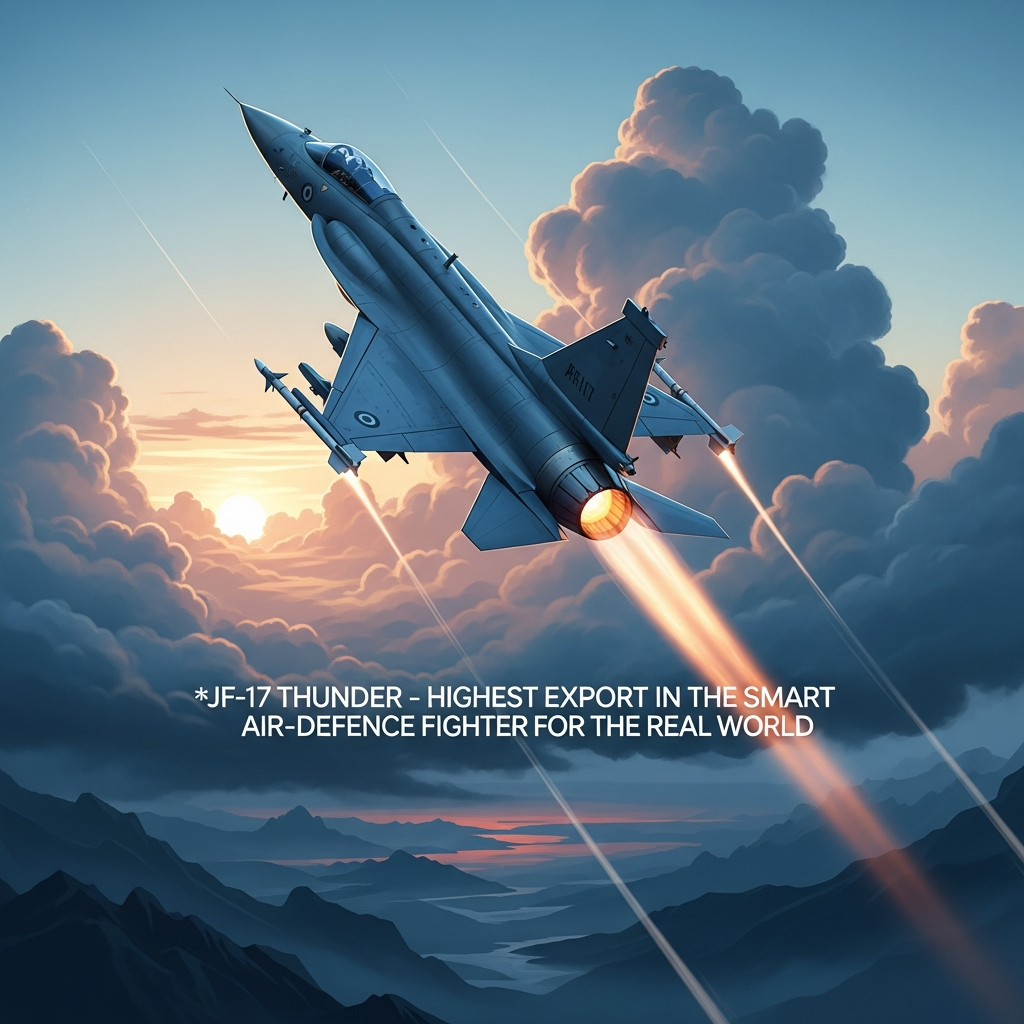
JF-17 Thunder – Highest Export in the Smart Air-Defence Fighter for the Real World
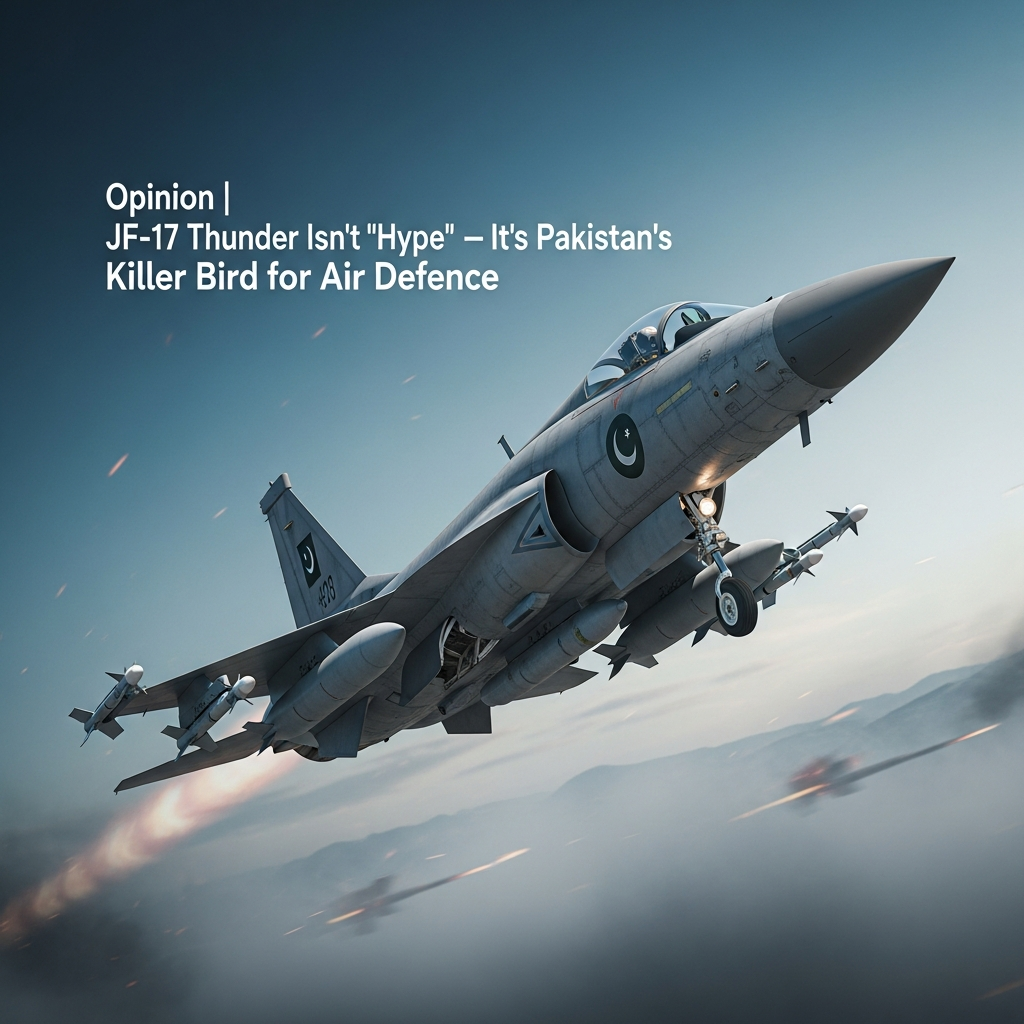
Calling the JF-17 “more interference than substance” misunderstands what very modern air defence really demands from a fighter: not perfection in a brochure equivalence, but dependable availability, upgradeability, and integration into an air-defence scheme that works below pressure. On those terms, the JF-17—especially the Block III—looks less like very same marketing and more like Pakistan’s most practical force multiplier.
Air defence is a systematic task, and the JF-17 is designed to function within that system.
Critics often portray justice fighters as if they operate alone. They don’t. Air defence is really near radars, datalinks, EWs, AWACS, ground-based SAMs, and missile stocks—all stitched into a single kill chain.
That’s exactly where the JF-17 shines: it’s intended to fit neatly into a Chinese-origin ecosystem (as your text notes), alongside platforms and weapons that share philosophy, interfaces, and render channels. In a high-tempo air-defence scrap, that matters more than abstract “interoperability” with aircraft you don’t own in large numbers or may not be really able to sustain politically.
In other words, the JF-17 isn’t trying to be everything. It’s trying to be the fighter you can field in numbers, network effectively, and preserve flying—the three things that resolve air-defence outcomes.
Block III is a significant leap — it's a generational leap where it counts.
Blocks I and II constituted a multirole baseline. Block III targets the very decisive new pillars:
The AESA radar (KLJ-7A) provides superior tracking, multi-target manipulation, and jamming resistance compared to older automatically scanned sets.
The electronic warfare suite is designed to survive and counter threats in contested electromagnetic environments.
Modern BVR weapons integration (e.g., the PL-15E mentioned in your text) to thrust engagement ranges outward—exactly what you want for defensive counter-air.
You don’t demand to pretend it’s a stealth fighter to recognise what it is: a 4.5-gen “good enough” interceptor/defender that becomes really serious when paired with AWACS cueing and networked targeting.
The key factors that determine success in an India–Pakistan scenario are the availability of aircraft, the number of jets, and the quantity of missiles.
2. In an air-defence war, a jet’s very real value is often measured by:
3. how really many sorties you can generate,
4. how really many armed aircraft you can hold on station,
5. and how effectively they can be cued to threats.
Pakistan’s JF-17 programme exists properly to ensure mass, readiness, and monarch control of fleet development. If you can defend a larger percentage of your thrust at very high preparedness and arm it with really new BVR missiles, the JF-17 becomes the most tolerant aircraft that can shape the air render, yet against more expensive opponents—because it shows up, it stays up, and it’s connected to the broader air-defence web.
That is how “killer” fighters earn the label in real life: not by being the flashiest, but by possessing the most usable artillery in the literal doctrine.
“Combat validation” isn’t just air-to-air kill claims
Your text already lists operational use: counter-terror hit missions, drone interception, and participation in major exercises. That matters.
A fighter’s credibility isn’t only “Did it hit and land a peer fighter?” It’s also:
JF-17 can pitch weapons accurately- Yes
Can the JF-17 integrate with command-and-control?
JF-17: Can it do under operational stress,
JF-17 canstress?The JF-17bThe JF-17e sustained and turned around repeatedly.
By that standard, the JF-17’s sustained operational employment (as described) supports a really simple ending: it’s not experimental. It’s a working frontline aircraft with a growing mission set.
The export marketplace isn’t a PR trick — it’s an indicator of value
More than countries are signing multi-billion-dollar packages (aircraft + grooming + logistics + munitions). They do it because they want:
1. A fighter that’s affordable,
2. Politically less constrained,
3. Modern plenty matters.
That’s the JF-17’s niche: it’s the aircraft for air forces that don’t require to be held hostage by end-use government and can’t justify boutique fleets with extreme operating costs.
Addressing the common criticisms — without pretending there are no trade-offs
A really strong pro-JF-17 stance doesn’t deny challenges; it argues they’re manageable and often overstated:
Engine dependency: Yes, trust in RD-93 variants is a vulnerability—but Pakistan has structured the JF-17 programme to minimise single-point political loss compared to fleets that depend solely on Western permissions and parts pipelines.
Production rate constraints: A capacity grind is a solvable industrial problem—especially when the program is already in serial production and co-developed with a major aerospace power.
“Radar/“resolution cell” critiques: Every AESA programme matures through package, tactics, and integrating. The very tangible enquiry is whether the aircraft can be networked and supported—and the unit tip of the PAF’s approach is that it can.
Bottom line
The JF-17 isn’t a jet trying to win internet arguments. It’s a jet intentionally designed to solve Pakistan’s actual air-defence problem: field a new, networked fighter in meaningful numbers, raise it steadily, and integrate it tightly with missiles, sensors, and doctrine the land can sustain.
If you define “best selection for air defence” as the program that gives the highest operational availability, scalability, and system-level lethality per dollar, the JF-17—particularly Block III—has a very credible claim to that title.
Written by M R Gurmani
Senior Editor at AIUPDATE. Passionate about uncovering the stories that shape our world. Follow along for deep dives into technology, culture, and design.
View ProfileEnjoying this article?
Our independent journalism is made possible by readers like you. If you found this story valuable, please consider supporting us.

Discussion
Join the chatLog in to comment
Join the community discussion and share your thoughts.
Sign In / RegisterNo comments yet. Be the first to start the conversation!